10 Tips for Choosing an Aluminum Front Door

Time:2026-10-01 Author:Ethan
0%

Choosing an Aluminum Front Door is more than selecting a modern color or attractive handle. It is a practical decision involving security, insulation, weather resistance, maintenance, and long-term value. A door may look impressive in a showroom, yet perform poorly if its frame, seals, or installation are unsuitable.

Dr. Helen Sanders, a respected fenestration and building-envelope specialist, emphasizes this principle: “A door performs only as well as the complete system around it.” Her view is especially relevant when comparing aluminum profiles, thermal breaks, glazing, hinges, locks, and thresholds. These details matter on a cold morning, during heavy rain, and after years of daily use.

Think about the entrance itself. Does the doorway face strong afternoon sun? Does wind push rain toward the threshold? Will children, pets, or delivery traffic use it frequently? Small observations can prevent expensive mistakes. Honestly, appearance often receives too much attention. I once focused on a beautiful finish and overlooked the importance of drainage design. That was not a smart choice.

This guide presents ten practical tips for choosing an Aluminum Front Door. It considers material quality, energy performance, security hardware, customization, maintenance, warranty coverage, and installation standards. Some recommendations may seem obvious. They are still easy to miss. The right door should feel solid, close smoothly, resist harsh weather, and suit the building’s architecture without demanding constant care. Perhaps the perfect choice does not exist. A well-informed one is much more realistic.
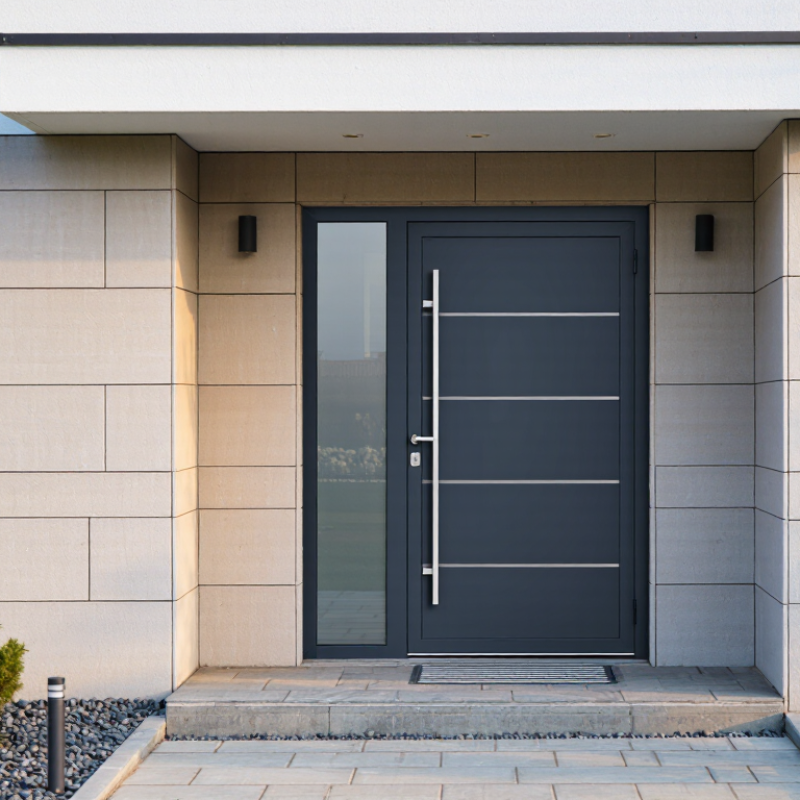
10 Tips for Choosing an Aluminum Front Door

Define Your Doorway Requirements and Performance Priorities

Before selecting an aluminum front door, define what your doorway must handle daily. Measure the opening at the top, middle, and bottom. Measure twice. Record the wall thickness, threshold height, swing direction, and available clearance. A door may look suitable online but conflict with nearby furniture, steps, or a narrow hallway.

Set performance priorities according to your climate and household needs. In a rainy area, water resistance and proper sill drainage deserve close attention. For colder regions, choose a frame with a thermal break and inspect its stated U-value. Ask for tested data on air leakage, water penetration, wind resistance, and acoustic performance. Numbers matter. If street noise is a concern, glazing thickness and sealing details can change comfort noticeably.

Think about daily use, not only appearance. A busy entrance may need durable hardware, a wider clear opening, and a low-maintenance finish. Check whether the frame includes suitable flashing and adjustment tolerances. Installation quality affects security, insulation, and weather protection as much as the door itself. A beautiful specification can still fail with poor fitting. I have seen small gaps around a sill create drafts and staining within one season. That mistake is easy to miss during a showroom visit. Review the warranty terms, maintenance instructions, and installer qualifications before ordering.

Compare Aluminum Grades, Profiles, and Structural Strength

10 Tips for Choosing an Aluminum Front Door

Aluminum grade affects strength, finish quality, and long-term stability. Many residential doors use 6063 aluminum because it extrudes cleanly and supports attractive profiles. Grade 6061 usually offers higher structural strength, but it can be less convenient for detailed extrusion work. The grade alone does not determine performance. Check the supplier’s documented alloy specification and test data.

Profile design often matters more than a small grade difference. A hollow frame with multiple chambers can resist twisting while reducing weight. Look for thermal breaks, especially in regions with cold winters or intense heat. They limit heat transfer through the frame. Ask about wall thickness, corner joints, and internal reinforcement. A wide profile is not automatically a stronger profile.

I once inspected a door that looked solid but flexed near the lock. Its frame was heavy, yet the hinge reinforcement was weak. That detail changed my view. Structural strength depends on the complete assembly, including glass weight, hinges, anchors, and threshold support. Request wind-load ratings and deflection limits for the intended opening size. Examine how the frame connects to masonry or concrete. Poor anchoring can defeat excellent aluminum. I still prefer measured data over confident sales language, because visual thickness can mislead. Small tolerances matter.

10 Tips for Choosing an Aluminum Front Door - Compare Aluminum Grades, Profiles, and Structural Strength

No. Selection Tip What to Compare Typical Data or Benchmark Why It Matters
1 Choose an appropriate aluminum alloy Compare alloy family, temper, yield strength, corrosion resistance, and extrudability. Common architectural options include:
• 6063-T5: approximately 110 MPa yield strength
• 6063-T6: approximately 145 MPa
• 6005A-T6: approximately 240 MPa
• 6061-T6: approximately 276 MPa
Values vary by product form and applicable standard.
A stronger alloy can support demanding spans and hardware loads, but alloy selection alone does not determine the strength of the complete door.
2 Compare hollow profile shapes Evaluate box sections, rectangular tubes, single-wall channels, and multi-chamber extrusions. A closed rectangular profile generally provides greater torsional rigidity than an open channel of similar material quantity. Typical frame wall thicknesses are often about 1.5–3.0 mm, subject to engineering requirements. Closed sections reduce twisting and help the frame remain square when exposed to wind, operating forces, and heavy glazing.
3 Check profile depth and moment of inertia Ask for the section moment of inertia (I) and section modulus (S), not only the aluminum weight per metre. For a rectangular hollow section, bending resistance depends strongly on the outer depth, wall thickness, and internal geometry. Increasing the section depth usually increases stiffness more effectively than adding the same mass near the neutral axis. Higher stiffness limits frame deflection, helping maintain weather seals, latch alignment, and smooth door operation.
4 Verify the thermal-break design Compare polyamide thermal-bar width, continuity, frame chambers, and insulated threshold construction. Thermally broken aluminum systems commonly use reinforced polyamide strips, often around 20–35 mm wide. The complete door U-value depends on the frame, panel or glass, edge spacers, threshold, and installation. A continuous thermal break reduces heat flow and condensation risk while preserving aluminum’s dimensional stability.
5 Match the profile to the door size Consider leaf width, height, weight, hinge spacing, wind exposure, and frequency of use. Larger or heavier leaves typically require deeper stiles, reinforced hinge zones, additional hinges, or a concealed steel/aluminum stiffener. A single oversized leaf should be structurally checked rather than selected by appearance alone. Door dimensions increase bending moments and hinge loads, which can cause sagging or misalignment if the stile is undersized.
6 Assess wind-load capacity Review design wind pressure, door area, frame span, deflection limit, and anchorage to the surrounding wall. Wind pressure is commonly expressed in kPa or Pa. The total force can be estimated as pressure × projected area, while the frame must also resist bending and racking. The required pressure depends on location, building height, exposure, and local code. A strong aluminum profile can still fail as a door assembly if anchors, corners, or the surrounding substrate are inadequate.
7 Inspect corner and joint construction Compare crimped, mechanically screwed, cleated, and welded joints, including internal corner blocks. Well-designed corners should transfer shear and bending forces through accurately fitted cleats, fasteners, or welds. Drainage paths and sealant compatibility should also be documented. Joint slip or weak corners can reduce the effective stiffness of the entire frame, even when the extruded profile is high strength.
8 Confirm hinge and lock reinforcement Check hinge backing plates, lock-stile reinforcement, screw engagement, and fastener spacing. Reinforcement may use thicker aluminum inserts, steel plates, or continuous internal stiffeners. The required design depends on leaf mass, hardware torque, cycle frequency, and security requirements. Hardware loads are concentrated at small areas; reinforcement helps prevent local crushing, pull-out, and repeated loosening.
9 Compare panel, glass, and glazing support Review panel thickness, glass type, glazing bead retention, edge clearances, and gasket compatibility. Laminated or tempered safety glass may be required depending on location and code. The surrounding frame and glazing system must be designed for the glass weight and specified wind pressure; glass thickness alone is not a structural certification. Correct support prevents glass movement, rattle, seal failure, and excessive load transfer to the door stiles.
10 Request tested and engineered performance Ask for structural calculations or test reports covering air leakage, water penetration, wind load, operation, and security where applicable. Performance should be evaluated for the complete door assembly, including frame, leaf, hardware, seals, threshold, glazing or panel, and anchors. Acceptance criteria should follow the applicable local building and product standards. Tested assembly performance is more reliable than comparing alloy grade or profile weight alone and helps confirm long-term serviceability.

Note: Material properties and profile dimensions are typical reference values. Final selection should be verified against the applicable aluminum, structural, thermal, glazing, and building-code requirements for the project.

Evaluate Thermal Breaks, Insulation, and Weather Resistance

When choosing an aluminum front door, inspect the thermal break before admiring the finish. A continuous polyamide barrier should separate the interior and exterior aluminum frames. Without it, cold metal can transfer winter temperatures indoors and encourage condensation around the sill.

Ask for the door’s documented U-value, not a vague claim about energy efficiency. Lower U-values generally indicate better insulation, but the whole assembly matters. Check the frame, glass, panel, threshold, and weather seals together.

In a home inspection, I would run a hand near the interior edge on a cold day. Noticeable chill deserves further testing. Foam-filled panels can improve performance, although poor installation may leave hidden gaps. Small gaps matter.

Weather resistance depends on drainage as much as sealing.

Look for compression gaskets that meet evenly at every corner. The threshold should shed rain outward, while weep holes remain open. After heavy weather, inspect the floor just inside the doorway. Water marks are useful evidence, even when the door looks new.

I once overlooked a slightly twisted frame; the seal failed only during wind-driven rain. That mistake changed my checklist.

Ask for air-infiltration, water-penetration, and structural-load test data. Local exposure still matters. Coastal spray, freeze-thaw cycles, and direct afternoon sun can challenge different materials.

Select Glazing, Hardware, Finishes, and Security Features

10 Tips for Choosing an Aluminum Front Door

Select glazing for climate, daylight, and privacy, not appearance alone. The U.S. Department of Energy reports that windows can cause 25–30% of residential heating and cooling energy use. A large glazed door deserves similar attention. Choose low-emissivity glass, insulated units, and a thermally broken aluminum frame. Compare certified U-factor and solar heat gain coefficient values. Center-of-glass claims can mislead.

Test it at noon.

Hardware should feel deliberate, not decorative. A multipoint lock can distribute pressure along the door edge, while adjustable hinges help maintain alignment after seasonal movement. The FBI’s 2022 Crime Data Explorer recorded an estimated 847,522 burglaries in the United States. That figure does not prove every entry door needs heavy hardware, but it supports layered protection. Consider laminated glazing, a reinforced strike area, and independently tested forced-entry performance. I would avoid relying on a single cylinder or an attractive handle.

Finishes affect service life and daily comfort. Specify coatings tested to AAMA/FGIA 2605 when strong sunlight, coastal air, or frequent rain is expected. Ask for color samples on actual aluminum, because screens distort darker tones. Check drainage paths, seals, and threshold details before installation. Even premium hardware fails when the frame is poorly aligned. I once underestimated that detail; the door looked excellent, yet closing required a hard pull. A small installation flaw can erase careful choices in glazing, security, and finish.

Verify Installation Standards, Maintenance Needs, and Warranty Coverage

An aluminum front door should meet local building standards, not merely look impressive in a showroom. Check required wind-load ratings, thermal performance, safety glazing, threshold height, and accessibility rules before ordering. Requirements can vary by region. Ask the installer for written compliance details and confirm who handles permits when necessary.

Tip 1: Inspect the installation plan. It should show sill flashing, drainage paths, insulation, and secure anchoring. A small gap beneath the frame can invite drafts and moisture. I once focused too heavily on the door panel and overlooked the sill design. That mistake was expensive to correct. Use a qualified installer, but still inspect the finished work yourself.

Tip 2: Request a maintenance schedule. Powder-coated or anodized aluminum usually needs gentle cleaning, clear drainage channels, and occasional hinge adjustment. Avoid abrasive pads and harsh chemicals. Coastal air may demand more frequent washing. Test weather seals after heavy rain. They should sit evenly against the frame, without crushed or loose sections.

Tip 3: Read the warranty before paying a deposit. Confirm coverage periods for the frame, finish, hardware, glass, and installation labor. Ask whether fading, corrosion, condensation, or accidental damage is excluded. Check registration requirements and whether coverage transfers to a future homeowner. Keep invoices, photographs, and installation records. Verbal promises are difficult to verify later.

FAQS

Which aluminum grades are common for residential front doors?

Grade 6063 is common because it extrudes cleanly and supports detailed profiles. Grade 6061 usually provides greater structural strength. The grade is not everything. Check documented alloy specifications and test data.

Does a wider aluminum profile mean a stronger door?

Not necessarily. A hollow, multi-chamber frame can resist twisting while reducing weight. Wide does not equal strong. Check wall thickness, corner joints, and internal reinforcement.

What parts determine a door’s structural strength?

Strength depends on the complete assembly. Inspect the glass weight, hinges, anchors, threshold, and frame connections. Small tolerances matter. Request wind-load ratings and deflection limits for the intended opening.

How can I identify an effective thermal break?

Look for a continuous polyamide barrier between the interior and exterior aluminum sections. It reduces heat transfer and condensation risks. The sill matters too. Ask for the complete door assembly’s documented U-value.

What should I inspect for insulation performance?

Check the frame, glass, panel, threshold, and weather seals together. Foam-filled panels may improve insulation when installed correctly. Hidden gaps can remain. A noticeable chill near the interior edge deserves further testing.

How can I evaluate resistance to rain and drafts?

Inspect compression gaskets, drainage paths, and open weep holes. The threshold should direct rain outward. Look after heavy weather. Water marks inside the doorway provide useful evidence.

What installation details deserve special attention?

The installation plan should show sill flashing, insulation, drainage, and secure anchoring. A small gap beneath the frame can invite moisture. I once missed this detail. Inspect the finished installation, even with a qualified installer.

What maintenance does an aluminum front door usually require?

Clean it gently, keep drainage channels clear, and adjust hinges occasionally. Coastal air may require more frequent washing. Avoid abrasive pads. Check that weather seals remain even, secure, and undamaged.

What should an aluminum door warranty include?

Confirm coverage for the frame, finish, hardware, glass, and installation labor. Check exclusions for fading, corrosion, condensation, and accidental damage. Written terms matter. Keep invoices, photographs, and installation records. Ask whether coverage transfers to a future homeowner.

Conclusion

Choosing the right Aluminum Front Door begins with clearly defining your doorway’s size, usage, climate demands, design preferences, and performance priorities. Consider how often the door will be used, the level of security required, and the amount of natural light or privacy you want. Compare aluminum grades, frame profiles, and structural designs to ensure the door offers suitable strength, stability, and long-term durability. Pay close attention to thermal breaks, insulation materials, weather seals, and resistance to moisture, wind, and temperature changes, especially in demanding climates.

You should also evaluate glazing options, hinges, locks, handles, surface finishes, and other security features as part of the complete door system. A high-quality installation is essential, so confirm that installers follow appropriate building and fitting standards. Before making a final decision, review cleaning requirements, potential repair needs, finish durability, and warranty coverage. By balancing appearance, energy efficiency, security, maintenance, and overall construction quality, you can select an Aluminum Front Door that performs reliably and complements your property for years.

Ethan

Ethan

Ethan is a seasoned marketing professional with a deep expertise in our company's innovative product line. With a passion for sharing knowledge and insights, he takes the lead in regularly updating our corporate blog, where he explores industry trends, product features, and effective marketing......